
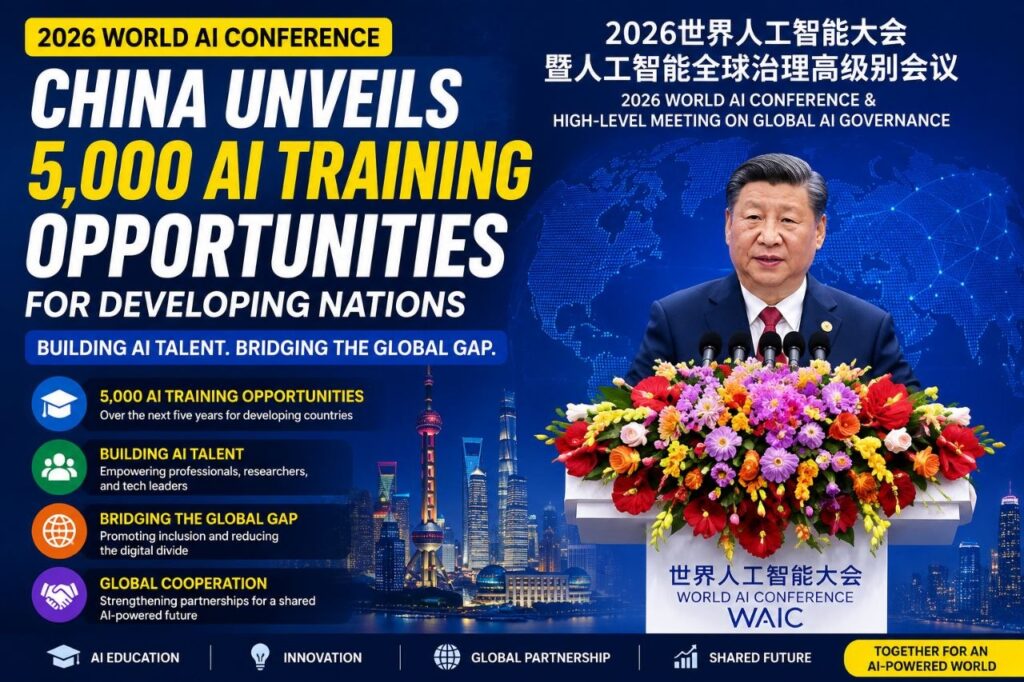
Artificial intelligence is rapidly transforming industries around the world, but access to AI education and technical expertise remains uneven, particularly in developing countries. In a move that could help bridge that gap, China has announced plans to provide 5,000 AI training opportunities for developing nations over the next five years.
The announcement was made during the 2026 World Artificial Intelligence Conference (WAIC) in Shanghai, where Chinese President Xi Jinping outlined a broader vision for expanding international cooperation in artificial intelligence. The initiative is aimed at helping developing countries build AI skills, strengthen digital capabilities, and prepare their workforces for the growing AI-driven economy.
What the Initiative Includes
According to Chinese officials, the program will offer 5,000 training opportunities and seminars focused on artificial intelligence for participants from developing countries over the next five years.
The initiative is expected to cover practical AI knowledge, technical training, and capacity building for professionals, researchers, government officials, and technology leaders. While full details about the application process and participating countries are yet to be released, the goal is to help nations strengthen their AI ecosystems and reduce the global digital divide.
Why This Matters
Artificial intelligence is becoming a key driver of innovation across sectors including healthcare, education, agriculture, finance, manufacturing, and transportation. However, many developing countries still face shortages of skilled AI professionals, research infrastructure, and training opportunities.
By investing in AI education, countries can better prepare students, entrepreneurs, and businesses to adopt emerging technologies and compete in the digital economy.
For nations in Africa, Asia, Latin America, and other developing regions, access to advanced AI training could help accelerate digital transformation while creating new employment opportunities for young professionals.
Potential Benefits for Nigeria and Other Developing Nations
If implemented successfully, the program could provide several long-term benefits.
Some of the expected advantages include:
- Improving AI skills among students and professionals
- Supporting innovation and technology startups
- Encouraging research collaborations
- Helping governments develop AI strategies
- Preparing workers for future technology-driven jobs
- Strengthening local digital economies
Countries like Nigeria have a rapidly growing technology sector and one of Africa’s largest populations of young developers and entrepreneurs. Access to international AI training could further strengthen the country’s growing innovation ecosystem.
Part of China’s Broader AI Strategy
The announcement is also part of China’s wider effort to increase international cooperation on artificial intelligence.
During the conference, President Xi Jinping emphasized that AI should be developed through global collaboration rather than being dominated by a single country. He called for more inclusive AI governance and encouraged stronger partnerships with developing regions, including Africa, ASEAN, Arab nations, Latin America, and BRICS members.
China also announced plans to expand cooperation through new international AI initiatives and knowledge-sharing programs designed to improve access to emerging technologies.
Challenges Ahead
Although the announcement has generated significant interest, several questions remain unanswered.
It is still unclear:
- Which countries will receive the training first.
- How participants will be selected.
- Whether the training will be delivered online, in person, or through hybrid programs.
- What certifications participants will receive.
- How the initiative will be funded over the five-year period.
These details are expected to become clearer as the program is rolled out.
Final Thoughts
Artificial intelligence is shaping the future of work, education, and innovation, making access to AI knowledge increasingly important for every nation. China’s decision to offer 5,000 AI training opportunities represents one of the largest international AI education initiatives announced in recent years and reflects the growing importance of global cooperation in technology development.
For developing countries, the initiative could provide valuable opportunities to build local expertise, strengthen innovation ecosystems, and prepare more people for careers in the rapidly evolving AI industry. While many implementation details are still to come, the announcement signals that AI education is becoming a central part of international development efforts and could play a meaningful role in narrowing the global digital skills gap.